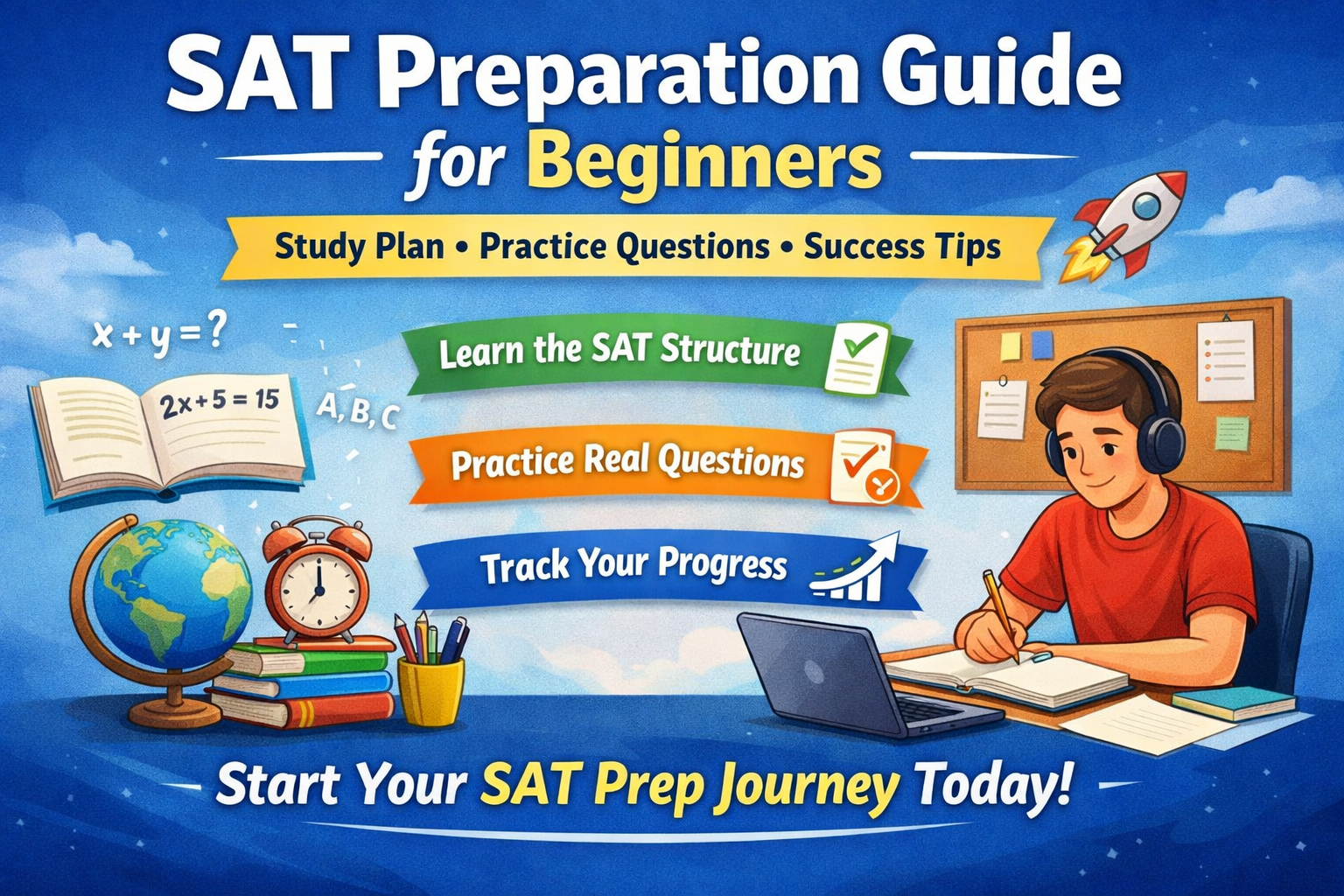
📝 SAT Prep Basics — How to Start Preparing Today
Introduction
Think of the SAT as a gateway. For many students, it’s the exam that decides whether they’ll study abroad, qualify for scholarships, or gain entry into their dream university. But here’s the truth: the SAT isn’t just about testing knowledge. It’s about testing how well you can think under pressure, manage time, and stay focused for hours.
If you’ve been putting off preparation because it feels overwhelming, you’re not alone. Thousands of students feel the same way. The good news? You don’t need expensive coaching centers or endless resources to succeed. What you need is a clear plan, consistent practice, and the right mindset. This article will walk you through everything — from understanding the exam structure to building a study schedule, practicing with real questions, using study guides, tracking progress, and staying motivated.
By the end, you’ll have a roadmap that feels achievable, not intimidating. And most importantly, you’ll realize that preparing for the SAT is less about being a “genius” and more about being disciplined and strategic.
—
1. Know the Exam Like a Friend
Imagine meeting someone new. At first, they seem mysterious, maybe even intimidating. But the more you learn about them, the less scary they become. The SAT is the same.
The exam has three main sections:
– Reading: You’ll read passages from literature, history, social sciences, and science. The questions test comprehension and evidence.
– Writing & Language: Think of this as editing. You’ll fix grammar, punctuation, and clarity in short passages.
– Math: Split into two parts — one with a calculator, one without. Topics include algebra, problem-solving, and data analysis.
– Essay (Optional): Some universities still ask for it, but many don’t. It’s about analyzing a passage and writing a structured response.
When you know the format, the SAT stops being a monster in the dark. It becomes a puzzle you can learn to solve. For example, if you’re strong in math but weaker in reading, you’ll know to spend more hours improving comprehension skills.
Tip: Print out the exam structure and stick it on your wall. Every time you study, remind yourself: “I’m training for Reading, Writing, and Math.” It keeps your focus sharp.
—
2. Build a Realistic Study Schedule
Here’s the mistake most students make: they try to study 6 hours a day for two weeks before the exam. That’s like trying to sprint the entire marathon — you’ll burn out.
Instead, think small and steady:
– Daily Routine: 1–2 hours a day is enough. Break it into 30‑minute blocks.
– Weekly Focus: Pick one skill each week. Week 1: Algebra basics. Week 2: Reading comprehension. Week 3: Grammar.
– Monthly Check‑ins: At the end of each month, take a full practice test. This shows you where you’re improving and where you need more work.
Here’s a sample 12‑week plan:
– Weeks 1–4: Focus on basics (algebra, grammar, reading strategies).
– Weeks 5–8: Advance to tougher topics (geometry, complex passages, essay practice).
– Weeks 9–12: Full practice tests + review mistakes.
Tip: Treat your study schedule like a gym workout. You wouldn’t expect six‑pack abs in a week, right? Same with SAT scores — progress takes time.
—
3. Practice Questions: Your Training Ground
Here’s where the real learning happens. Reading guides is helpful, but solving questions is what builds muscle memory.
Try these sample questions:
1. Solve for \(x\): \(2x + 5 = 15\)
2. A line has slope \(m = 3\) and passes through point \((2,4)\). Write its equation in slope‑intercept form.
3. Solve the system:
\[
y = 2x + 3 \\
y = -x + 6
\]
4. A student buys 3 pencils and 2 pens for \$2.50. Each pencil costs \$0.50. What is the price of one pen?
5. If \(f(x) = 2x^2 – 3x + 1\), find \(f(4)\).
For Reading, practice passages are equally important. Example:
*”The author argues that technological progress often comes at the expense of privacy. Which evidence best supports this claim?”*
The more you practice, the more familiar the patterns become. Soon, you’ll recognize question types instantly.
Tip: Don’t just check answers. Review why you got a question wrong. Was it a careless mistake? Did you misread the passage? Did you forget a math formula? Every mistake is a lesson.
—
4. Study Guides: Your Roadmap
Think of study guides as cheat sheets for success. They don’t give you answers, but they show you the smartest way to approach problems.
– Reading: Skim the passage first, underline evidence, then answer. Don’t get stuck on one sentence.
– Writing: Watch out for subject‑verb agreement, misplaced commas, and awkward phrasing.
– Math: Always isolate variables step by step. Double‑check by plugging your answer back into the equation.
You don’t need expensive books. Free PDFs, online articles, and even YouTube tutorials can serve as effective guides. The key is consistency — use them regularly, not just once.
—
5. Track Your Progress Like a Coach (250 words)
Here’s a secret: the best athletes don’t just train, they track their progress. You should too.
– Notebook Method: Write down your scores after each practice test.
– Weekly Reflection: At the end of each week, ask yourself: What improved? What mistakes repeated? What needs focus next week?
– Celebrate Small Wins: Even moving from 5/10 correct answers to 7/10 is progress.
Tracking progress builds confidence. It shows you that your effort is paying off, even if the improvement feels slow.
Tip: Share your progress with a friend or family member. Accountability makes you more consistent.
—
6. Stay Motivated When It Gets Tough
Let’s be honest — SAT prep isn’t always fun. There will be days when you’d rather scroll Instagram or watch Netflix. That’s normal.
Here’s how to stay motivated:
– Reward Yourself: Watch a movie after finishing a practice test.
– Join Communities: Online student groups can keep you accountable.
– Visualize Success: Imagine opening your acceptance letter from your dream university. That vision will push you through tough days.
Remember, thousands of students worldwide are preparing just like you. You’re not alone in this journey.
—
Conclusion
Preparing for the SAT is like training for a marathon. It takes time, effort, and consistency — but it’s absolutely doable. Start today with a simple plan: understand the exam, build a realistic schedule, practice daily, use study guides, and track your progress.
Don’t wait for the “perfect time” to begin. The perfect time is now. Every small step you take today brings you closer to the score you want tomorrow. And when exam day arrives, you won’t just be prepared — you’ll be confident, calm, and ready to succeed.