How to Beat Procrastination and Actually Start Studying
🧠 Introduction: The Real Enemy Isn’t the Exam — It’s the Delay
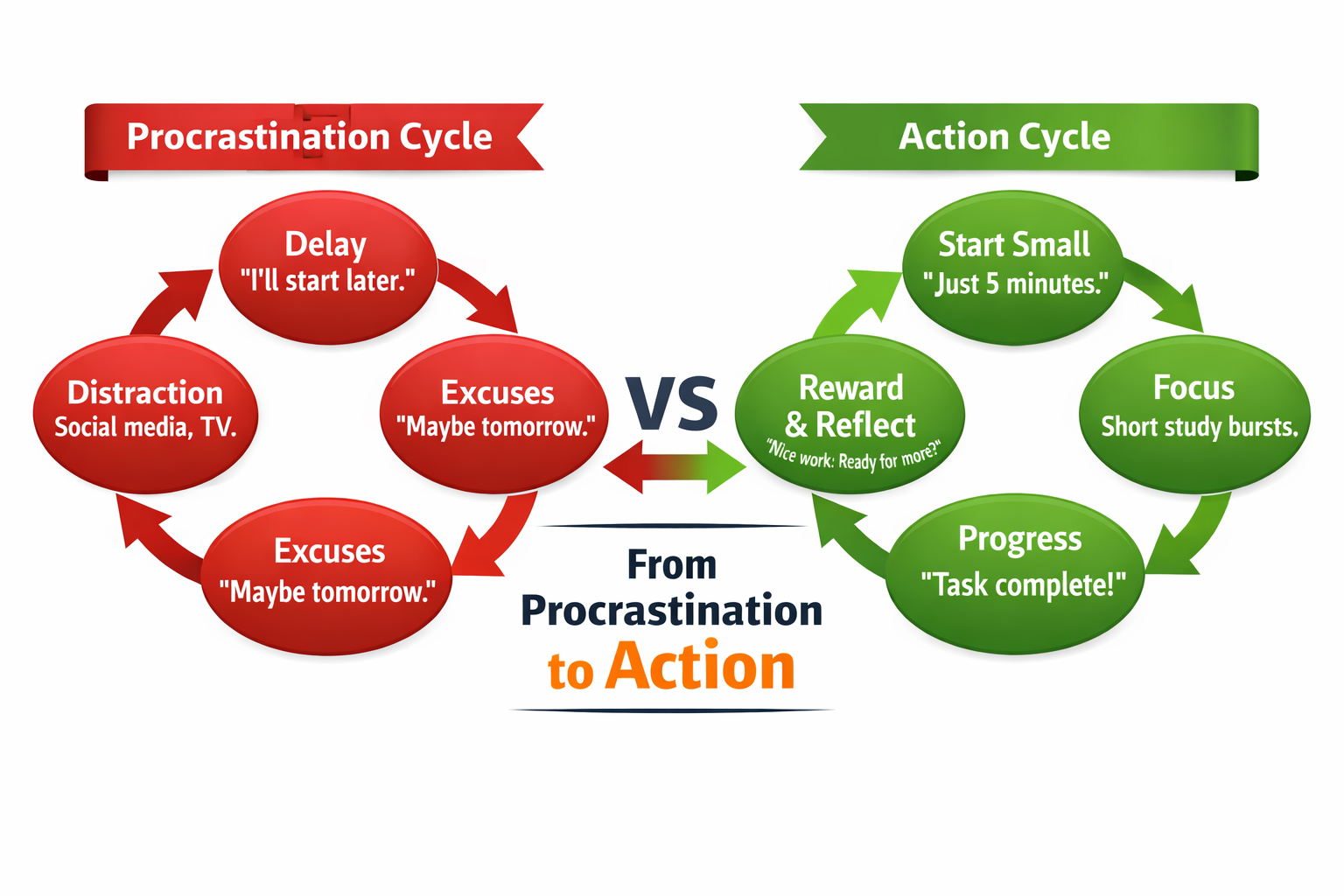
You’ve got your notes ready, your books stacked, and your phone on silent. But somehow, you still end up scrolling, snacking, or convincing yourself that “I’ll start in 10 minutes.”
Sound familiar? You’re not lazy — you’re human.
Procrastination is the invisible wall between intention and action. Every student faces it, but few know how to break it. This article will show you how to beat procrastination, build momentum, and finally start studying — even when you don’t feel like it.
And if you’ve already read “10 Exam Hacks Teachers Don’t Tell You” and “The 30-Minute Study Plan That Actually Works,” this is the missing piece that ties them together. You’ve learned how to study smart — now you’ll learn how to start smart.
⏰ Step 1: Understand Why You Delay
Before fixing procrastination, you need to understand it.
Most students delay studying because of one of these reasons:
- Fear of failure: “What if I study and still don’t do well?”
- Overwhelm: “There’s too much to cover — where do I even begin?”
- Perfectionism: “I’ll start when I have the perfect plan.”
- Distraction: “I’ll just check one message…”
💡 Truth bomb: Procrastination isn’t laziness — it’s avoidance. You’re avoiding discomfort, not work.
👉 Engagement tip: Comment below which reason hits closest to home. You’ll be surprised how many students feel the same.
🪄 Step 2: The 5-Minute Rule — Trick Your Brain to Start
Here’s a secret psychologists love: you don’t need motivation to start — you need momentum.
Try the 5-Minute Rule:
Tell yourself you’ll study for just five minutes.
Once you begin, your brain’s resistance drops, and you often keep going far longer.
💡 Why it works: Starting is the hardest part. Once you cross that line, your brain switches from “avoid” to “engage.”
🔗 Connection to Previous Articles:
In “The 30-Minute Study Plan,” we talked about short, focused bursts. The 5-Minute Rule is your entry point — it gets you into that first burst effortlessly.
📋 Step 3: Create a “Start Ritual”
Every athlete has a warm-up. Every musician has a pre-show routine. You need a study ritual — a small, repeatable action that signals your brain it’s time to focus.
Examples:
- Brew a cup of tea.
- Clear your desk.
- Play a specific playlist.
- Open your notebook and write the date.
💡 Why it works: Rituals create consistency. They turn studying into a habit, not a chore.
👉 Engagement tip: Share your study ritual in the comments — your idea might inspire someone else.
📚 Step 4: Use the “Two-Minute Prep” Technique
Before diving into your subject, spend two minutes preparing your space and mind.
- Put your phone out of reach.
- Open only the materials you need.
- Write your goal for the session (“I’ll finish Chapter 3”).
💡 Why it works: Preparation reduces friction. The fewer decisions you make, the easier it is to start.
🔗 Connection to Previous Articles:
This complements Hack #1 from “10 Exam Hacks Teachers Don’t Tell You” — “Set the Scene.” You’re creating an environment that invites focus.
🧩 Step 5: Break the “All-or-Nothing” Mindset
Students often think: “If I can’t study for two hours, it’s not worth starting.”
That’s the trap.
Studying for 10 minutes is infinitely better than zero minutes.
Progress compounds — small sessions add up.
💡 Why it works: Your brain loves completion. Finishing small tasks releases dopamine, motivating you to do more.
👉 Challenge: Try studying for just 10 minutes today. Comment how far you got — you’ll be amazed.
🔥 Step 6: Make It Fun (Yes, Really)
Studying doesn’t have to feel like punishment.
Here’s how to make it enjoyable:
- Turn notes into colorful mind maps.
- Use gamified apps like Quizlet or Kahoot.
- Study with a friend and quiz each other.
- Reward yourself after each milestone.
💡 Why it works: Fun activates curiosity — the most powerful learning emotion.
🔗 Connection to Previous Articles:
Remember Hack #9 (“Micro-Rewards”) from “10 Exam Hacks Teachers Don’t Tell You”? Combine it with this step — make rewards part of your fun routine.
🧠 Step 7: Visualize the Outcome
Close your eyes and imagine walking out of your exam room smiling, confident, and proud.
Visualization isn’t daydreaming — it’s mental rehearsal.
💡 Why it works: Your brain can’t distinguish between imagined success and real success. Visualization builds belief, which fuels action.
👉 Engagement tip: Write one sentence describing how you’ll feel after acing your exam. Post it below — make it your public promise.
🕹 Step 8: Use the “Pomodoro Power-Up”
If you’ve mastered the 30-minute plan, take it up a notch with the Pomodoro Technique:
- Study for 25 minutes.
- Take a 5-minute break.
- Repeat four times, then take a longer break.
💡 Why it works: It keeps your brain fresh and prevents burnout.
🔗 Connection to Previous Articles:
This builds directly on “The 30-Minute Study Plan.” You’re now turning that concept into a rhythm — a sustainable cycle of focus and rest.
🧩 Step 9: Accountability — The Secret Weapon
Tell someone your goal. It could be a friend, sibling, or even your study group.
When others know your plan, you’re more likely to follow through.
💡 Why it works: Accountability adds gentle pressure. You don’t want to disappoint others — or yourself.
👉 Engagement tip: Tag your study buddy in the comments and start a mini challenge: “Let’s both study for 30 minutes today!”
🪞 Step 10: Reflect and Adjust
At the end of each day, ask yourself:
- What worked today?
- What distracted me?
- How can I improve tomorrow?
💡 Why it works: Reflection turns experience into growth. You’re not just studying — you’re mastering your own habits.
🔗 Connection to Previous Articles:
This mirrors the reflection step from “The 30-Minute Study Plan.” Together, they form a feedback loop — plan, act, reflect, improve.
🌱 Bonus: The “Momentum Journal”
Start a small notebook called your Momentum Journal.
Each day, write:
- What you studied.
- How long you focused.
- One thing you’re proud of.
💡 Why it works: Tracking progress visually keeps motivation alive. You’ll see how far you’ve come — and that’s addictive.
👉 Engagement tip: Post a photo of your first journal entry on social media with the hashtag #StudyMomentum — inspire others to start theirs.
🧩 How This Article Connects the Series
If you’ve followed this series from the start, here’s how it all fits together:
| Article | Focus | How It Connects |
| 10 Exam Hacks Teachers Don’t Tell You | Smart techniques and hidden strategies | Gives you the tools to study efficiently. |
| The 30-Minute Study Plan That Actually Works | Time management and focus | Shows you how to use those tools daily. |
| How to Beat Procrastination and Actually Start Studying | Motivation and habit building | Helps you start and sustain the process. |
Together, they form a complete student success system — motivation, method, and mastery.
📌 Conclusion: Start Small, Win Big
Procrastination doesn’t vanish overnight. But every time you start — even for five minutes — you’re training your brain to act instead of avoid.
So here’s your challenge:
Tonight, set a timer for five minutes.
Open your notes.
Start.
You’ll be amazed how quickly five minutes turn into thirty, and thirty into success.
🔗 Series Connection:
If you haven’t yet, read “10 Exam Hacks Teachers Don’t Tell You” for clever shortcuts, and “The 30-Minute Study Plan That Actually Works” for structure. Combine all three, and you’ll have a study system that beats stress, procrastination, and burnout — for good.
💬 Join the Conversation
- What’s your biggest procrastination trigger?
- Which trick from this article will you try first?
- Share your progress using #StudentPointChallenge on Facebook