The 30-Minute Study Plan That Actually Works
🎓 Introduction: Why Short Study Sessions Beat Long Ones
Remember those endless nights of cramming we talked about in “10 Exam Hacks Teachers Don’t Tell You”? You probably recall the part where I said teachers rarely share the hidden tricks that make studying easier. Well, here’s the next secret: you don’t need hours to study effectively — you just need 30 minutes.
Think about it. How many times have you sat down for a “long study session” only to end up scrolling your phone, daydreaming, or rereading the same page? Long sessions drain your energy. Short, structured bursts of study — like the 30-minute plan — keep your brain sharp, focused, and motivated.
This article builds on the hacks we discussed earlier, giving you a step-by-step plan that turns half an hour into a powerhouse of productivity.
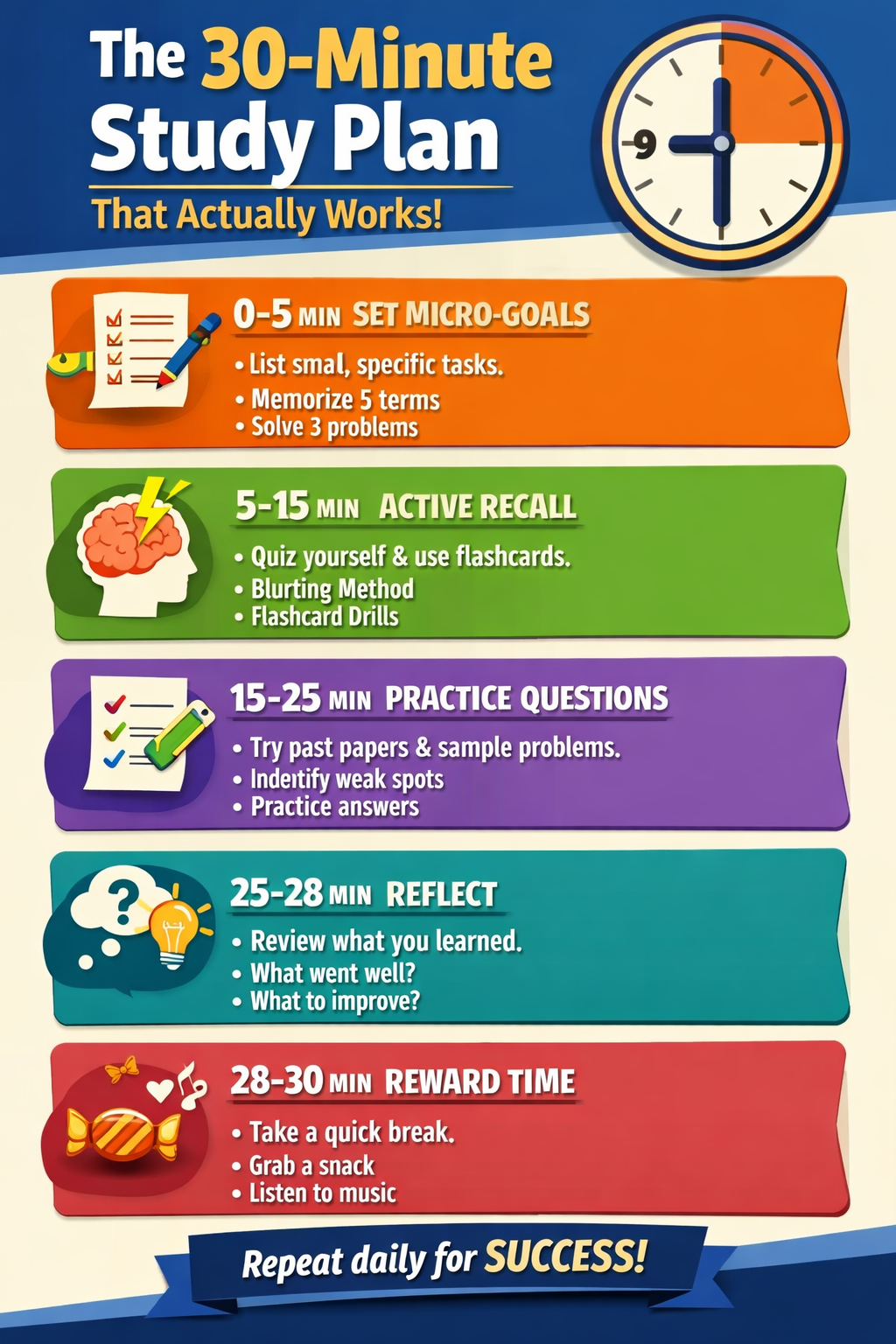
⏱ Step 1: Set Micro-Goals (First 5 Minutes)
Instead of vague goals like “study math,” break your session into tiny, achievable tasks.
Examples:
- Memorize 5 definitions.
- Solve 3 practice problems.
- Review one diagram.
💡 Why it works: Micro-goals give your brain quick wins. Each small success builds momentum and confidence.
👉 Engagement tip: Write your micro-goals on sticky notes. Snap a photo and share it with your study group — accountability makes it fun.
🔗 Connection to Previous Article: This is similar to Hack #4 (“Legal Cheat Sheets”). Just like condensing notes forces you to prioritize, micro-goals force you to focus on what matters most.
✍️ Step 2: Active Recall (Next 10 Minutes)
Forget passive reading. The most powerful technique is active recall — forcing your brain to retrieve information.
Ways to do it:
- Use flashcards.
- Try the “blurting” method (write everything you know without notes).
- Quiz yourself out loud.
💡 Why it works: Active recall strengthens memory pathways. It’s like lifting weights for your brain.
👉 Challenge: Set a timer for 10 minutes and quiz yourself on one topic. Post your score in your group chat — friendly competition keeps you motivated.
🔗 Connection to Previous Article: This ties directly to Hack #7 (“The Blurting Method”). In fact, blurting is one of the fastest ways to fill this 10-minute slot.
📄 Step 3: Practice with Past Papers (Next 10 Minutes)
Grab a past paper or practice questions. Don’t aim to finish everything — just skim and attempt a few.
Focus on:
- Spotting common question patterns.
- Identifying weak areas.
- Practicing concise answers.
💡 Why it works: Exams often recycle concepts. Past papers help you predict what’s coming and reduce anxiety.
👉 Engagement tip: Share a “Question of the Day” with friends. Everyone answers, then compare solutions. It’s collaborative learning at its best.
🔗 Connection to Previous Article: This complements Hack #6 (“Use AI Tools for Practice Questions”). AI can generate quizzes, but past papers give you the real flavor of exam questions.
🪞 Step 4: Reflection (3 Minutes)
Pause and ask yourself:
- What did I learn?
- What’s still unclear?
- What should I tackle next?
💡 Why it works: Reflection cements knowledge. It’s like pressing “save” on your brain’s hard drive.
👉 Try journaling: Write one sentence about what you mastered today. Over time, you’ll see your progress grow.
🔗 Connection to Previous Article: This echoes Hack #2 (“Reverse Teaching”). Reflection is like teaching yourself — you’re reviewing what you know and identifying gaps.
🍫 Step 5: Reward Yourself (2 Minutes)
End with a micro-reward:
- A piece of chocolate.
- A short song.
- A quick scroll through Instagram.
💡 Why it works: Rewards release dopamine, making your brain associate studying with pleasure.
👉 Engagement tip: Share your reward ritual with friends. “I earn a cookie after every 30 minutes!” It’s fun and motivating.
🔗 Connection to Previous Article: This is Hack #9 (“Micro-Rewards”). The difference? Here, it’s built into the plan so you never forget to celebrate small wins.
🎯 Why This Plan Works
- Short bursts prevent fatigue.
- Active recall builds strong memory.
- Past papers prepare you for real exam conditions.
- Reflection ensures you don’t just study — you learn.
- Rewards keep you coming back for more.
🔗 Connection to Previous Article: Remember Hack #10 (“Sleep — The Ultimate Exam Hack”)? Pairing this 30-minute plan with proper rest makes your study sessions unstoppable.
📊 Sample 30-Minute Schedule
- 0–5 min → Micro-goals setup
- 5–15 min → Active recall
- 15–25 min → Past paper practice
- 25–28 min → Reflection
- 28–30 min → Reward
Repeat this cycle twice a day, and you’ll cover more ground than hours of unfocused cramming.
🧠 Real-Life Example: Sara’s Story
Sara, a college student, struggled with biology. She switched to the 30-minute plan:
- Morning: memorized 5 definitions.
- Afternoon: practiced 3 diagrams.
- Evening: solved 2 past paper questions.
Within a week, she felt more confident than after months of long study sessions. Her secret? Consistency, not intensity.
👉 Engagement tip: Share your own “study success story” in the comments. Inspire others with how short bursts helped you.
📌 Conclusion: Small Steps, Big Results
The 30-minute study plan isn’t magic — it’s science. By breaking learning into short, focused bursts, you’ll retain more, stress less, and walk into exams prepared.
So tonight, don’t plan a 3-hour cram. Set a timer for 30 minutes. Try this plan. And watch your grades — and confidence — rise.
🔗 If you loved the hacks in “10 Exam Hacks Teachers Don’t Tell You,” this plan is the natural next step. Hacks give you tools; the 30-minute plan shows you how to use them daily.
✨ Try this plan and share your results !
- “Try this 30-minute plan today and comment how it worked for you!”
- “Do you study better in short bursts or long sessions?”
- “The 30-minute study plan that beats cramming — students swear by it!”
- “Missed our first article? Read ‘10 Exam Hacks Teachers Don’t Tell You’ to unlock even more secrets.”
📘 Related Article
Loved the 30‑minute study plan? Check out our first article: 10 Exam Hacks Teachers Don’t Tell You
Discover secret tips and clever tricks to boost your exam scores! Read More »