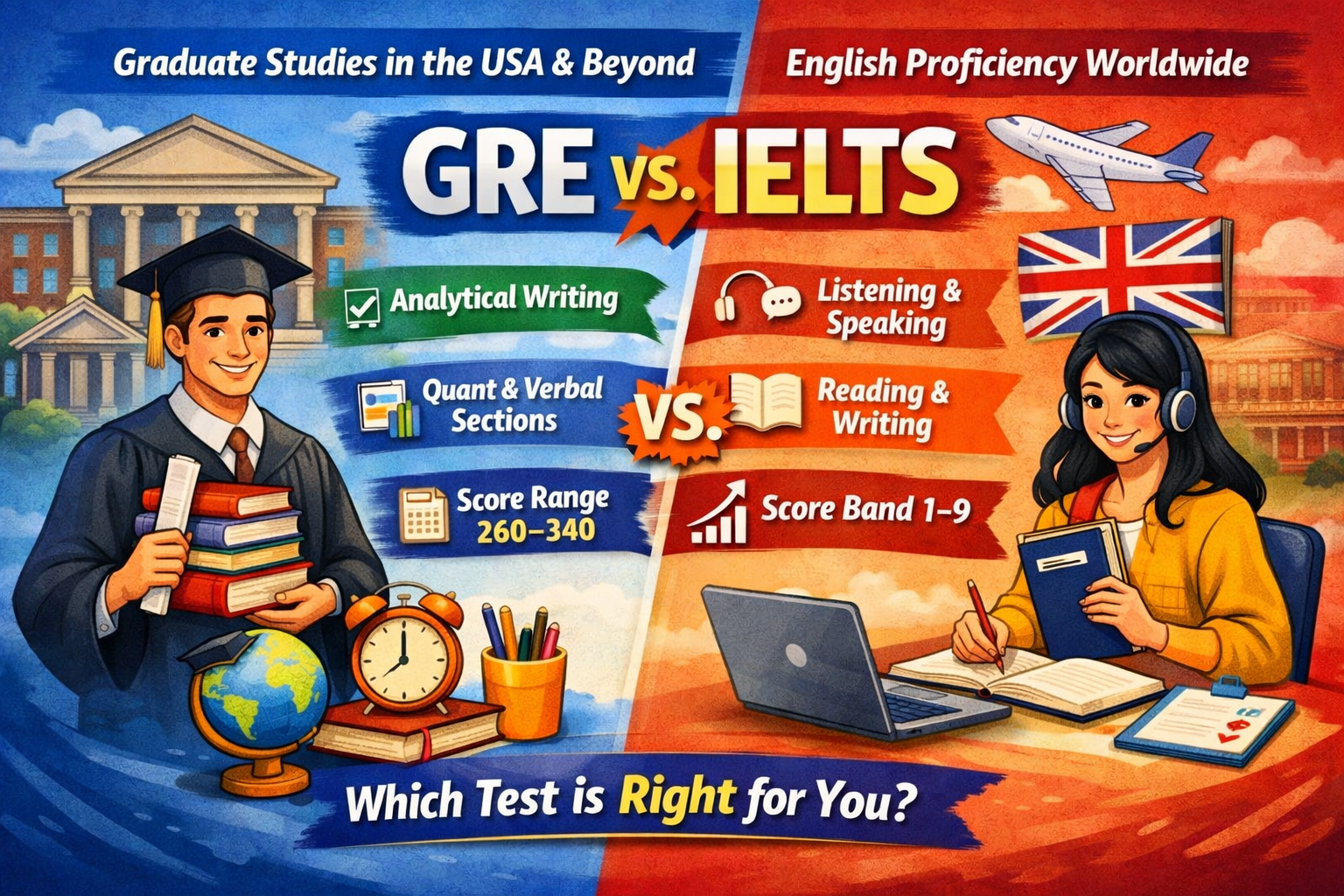
🌍 GRE vs. IELTS — Which Exam Should You Take?
Introduction
If you’re dreaming of studying abroad, you’ve probably heard these two acronyms tossed around: GRE and IELTS. They sound intimidating, don’t they? One tests your academic reasoning, the other your English fluency. Both can open doors to universities around the world. But which one is right for you?
Choosing between GRE and IELTS isn’t just about difficulty; it’s about purpose. The GRE is your ticket to graduate programs—Master’s or PhD—especially in the United States and other English‑speaking countries. The IELTS, on the other hand, proves that you can communicate effectively in English, whether you’re applying for undergraduate studies, jobs, or immigration.
This guide breaks down both exams in plain language. You’ll learn what each test measures, who needs it, how to prepare, and how to decide which fits your goals. Think of it as a friendly chat with someone who’s been through the process and wants you to succeed.
🎓 What Is the GRE?
The Graduate Record Examination (GRE) is designed for students applying to graduate schools worldwide. It’s not about memorizing facts—it’s about showing how you think.
Structure:
- Verbal Reasoning: Tests vocabulary, reading comprehension, and critical thinking.
- Quantitative Reasoning: Focuses on math—algebra, geometry, data analysis, and logic.
- Analytical Writing: You’ll write two essays: one analyzing an issue, another evaluating an argument.
Scoring:
Each section is scored separately, with a total range from 260 to 340. The writing section is graded on a 0–6 scale.
Purpose:
Universities use GRE scores to gauge whether you’re ready for graduate‑level work. A strong score can boost your application, especially if your GPA isn’t stellar.
Example:
Imagine you’re applying for a Master’s in Computer Science. The admissions committee wants to know if you can handle advanced problem‑solving and communicate ideas clearly. Your GRE score gives them that insight.
Tip:
Don’t fear the math section—it’s not rocket science. Most questions test logic more than formulas. Practice regularly, and you’ll start seeing patterns that make the test predictable.
🗣️ What Is the IELTS?
The International English Language Testing System (IELTS) measures how well you can use English in real‑life situations. It’s accepted by universities, employers, and immigration departments in over 140 countries.
Structure:
- Listening: You’ll hear conversations and lectures, then answer questions.
- Reading: Tests comprehension of academic and general texts.
- Writing: Two tasks—one describing data or a graph, another an essay expressing your opinion.
- Speaking: A face‑to‑face interview with an examiner.
Scoring:
Each section is graded on a band scale from 1 to 9. Most universities require a minimum of 6.5 or 7.
Purpose:
IELTS proves your English proficiency. It’s essential for students from non‑English‑speaking countries who want to study, work, or migrate abroad.
Example:
If you’re applying for an undergraduate program in Canada or the UK, the university wants to ensure you can follow lectures, write essays, and participate in discussions—all in English.
Tip:
Practice speaking English daily. Record yourself answering sample questions. The goal isn’t perfect grammar—it’s confidence and clarity.
⚖️ GRE vs. IELTS — The Key Differences
Let’s compare them side by side so you can see how they differ.
| Feature | GRE | IELTS |
| Purpose | Graduate school admission | English proficiency for study/work |
| Sections | Verbal, Quantitative, Writing | Listening, Reading, Writing, Speaking |
| Score Range | 260–340 | Band 1–9 |
| Duration | ~3 hours 45 minutes | ~2 hours 45 minutes |
| Focus | Analytical & academic reasoning | Communication & language skills |
| Accepted By | U.S., Canada, Europe, Australia | Over 140 countries worldwide |
| Retake Policy | Once every 21 days | Anytime after results |
In simple terms:
- Take the GRE if you’re applying for graduate programs (Master’s or PhD).
- Take the IELTS if you need to prove English proficiency for undergraduate studies, work visas, or immigration.
Sometimes you need both.
For example, a student applying for a Master’s in Engineering in the U.S. might need GRE for academic evaluation and IELTS for language proof.
Tip:
Check your target university’s website. Some accept TOEFL instead of IELTS, and some waive GRE requirements for certain programs.
🧭 How to Choose the Right Exam
Choosing between GRE and IELTS depends on your goals. Ask yourself these questions:
- What program am I applying for?
- Graduate programs → GRE.
- Undergraduate or diploma programs → IELTS.
- Where am I applying?
- U.S. universities often require GRE.
- U.K., Canada, Australia, and New Zealand emphasize IELTS.
- Do I need proof of English proficiency?
- If English isn’t your first language, IELTS is mandatory.
- Do I enjoy math and analytical reasoning?
- If yes, GRE might suit you better.
- Do I want flexibility?
- IELTS is shorter and easier to retake. GRE requires more preparation time.
Real‑world example:
Sara, a student from Pakistan, wanted to pursue a Master’s in Psychology in Canada. Her university required both GRE and IELTS. She prepared for GRE first, focusing on vocabulary and analytical writing, then spent a month improving her IELTS speaking skills. She got admission with scholarships.
Your choice should align with your destination and career path—not with what others are doing.
📚 Preparation Tips for Both Exams
No matter which exam you choose, preparation is key. Here’s how to get started.
For GRE:
- Start Early: Give yourself at least 3–4 months.
- Vocabulary Building: Read articles, note new words, and use flashcards.
- Math Practice: Focus on logic and problem‑solving, not memorization.
- Mock Tests: Simulate real exam conditions to build stamina.
- Writing Practice: Analyze sample essays and learn how to structure arguments.
For IELTS:
- Listen Daily: Podcasts, news, and English shows improve comprehension.
- Speak Confidently: Practice with friends or record yourself.
- Read Widely: Newspapers, blogs, and academic texts help with vocabulary.
- Write Essays: Focus on clarity and coherence.
- Take Practice Tests: Familiarize yourself with timing and question types.
Bonus Tip:
Don’t study in isolation. Join online communities or local study groups. Discussing questions helps you learn faster and stay motivated.
💡 Common Mistakes to Avoid
- Cramming: Both exams test understanding, not memorization.
- Ignoring Weak Areas: Focus on what challenges you most.
- Skipping Mock Tests: Practice under timed conditions.
- Neglecting English Basics: Even GRE essays require clear writing.
- Overthinking Scores: Aim for improvement, not perfection.
🌟 Staying Motivated
Preparing for international exams can feel lonely. But remember why you started—your dream university, your career goals, your future abroad.
Set small milestones: finish one section, complete one mock test, learn ten new words. Celebrate each win. Motivation grows from progress, not pressure.
Visualize success: imagine walking across your new campus, meeting classmates from around the world, and realizing that all those study hours were worth it.
Conclusion
The GRE and IELTS are gateways to global education. They test different skills but share one goal—to help you prove your readiness for international opportunities.
If you’re aiming for graduate school, the GRE is your challenge. If you’re proving English proficiency, IELTS is your path. Some students take both, and that’s perfectly fine.
Start today. Choose your exam, set a schedule, and commit to steady progress. The journey may be tough, but the reward—a world of possibilities—is worth every effort.